Every ICU in India runs on electricity and trust — trust that the ventilator will deliver 500 mL when it says 500 mL, that the syringe pump won’t drift by 15%, that the defibrillator will charge in under 10 seconds. The person responsible for that trust is not the doctor, not the nurse, and not the hospital’s IT team.
It’s the Biomedical Equipment Technician.
In India this career goes by several names — Biomedical Technician, HTM (Healthcare Technology Management) Engineer, Clinical Equipment Engineer, Medical Electronics Technician. The job title on the offer letter matters less than what happens when a patient monitor alarms at 2 AM and nobody knows why.
India’s medical device market was valued at approximately $17.86 billion in 2026 and is projected to grow to $44.76 billion by 2034 at a CAGR of 12.20%, according to Fortune Business Insights. The Ayushman Bharat Pradhan Mantri Jan Arogya Yojana has already issued over 420 million beneficiary cards. The PM Health Infrastructure Mission invested ₹64,180 crore between 2021 and 2026 to establish over 1.75 lakh Ayushman Arogya Mandirs across the country. Every one of those facilities needs equipment. Every piece of equipment needs someone qualified to keep it running.
The demand is real. The supply of qualified people is not keeping pace.
This guide covers what the work actually looks like inside Indian hospitals, verified salary figures by employer type, the certification path that now has mutual recognition with the US AAMI body, and the honest picture of where this career can and cannot go.
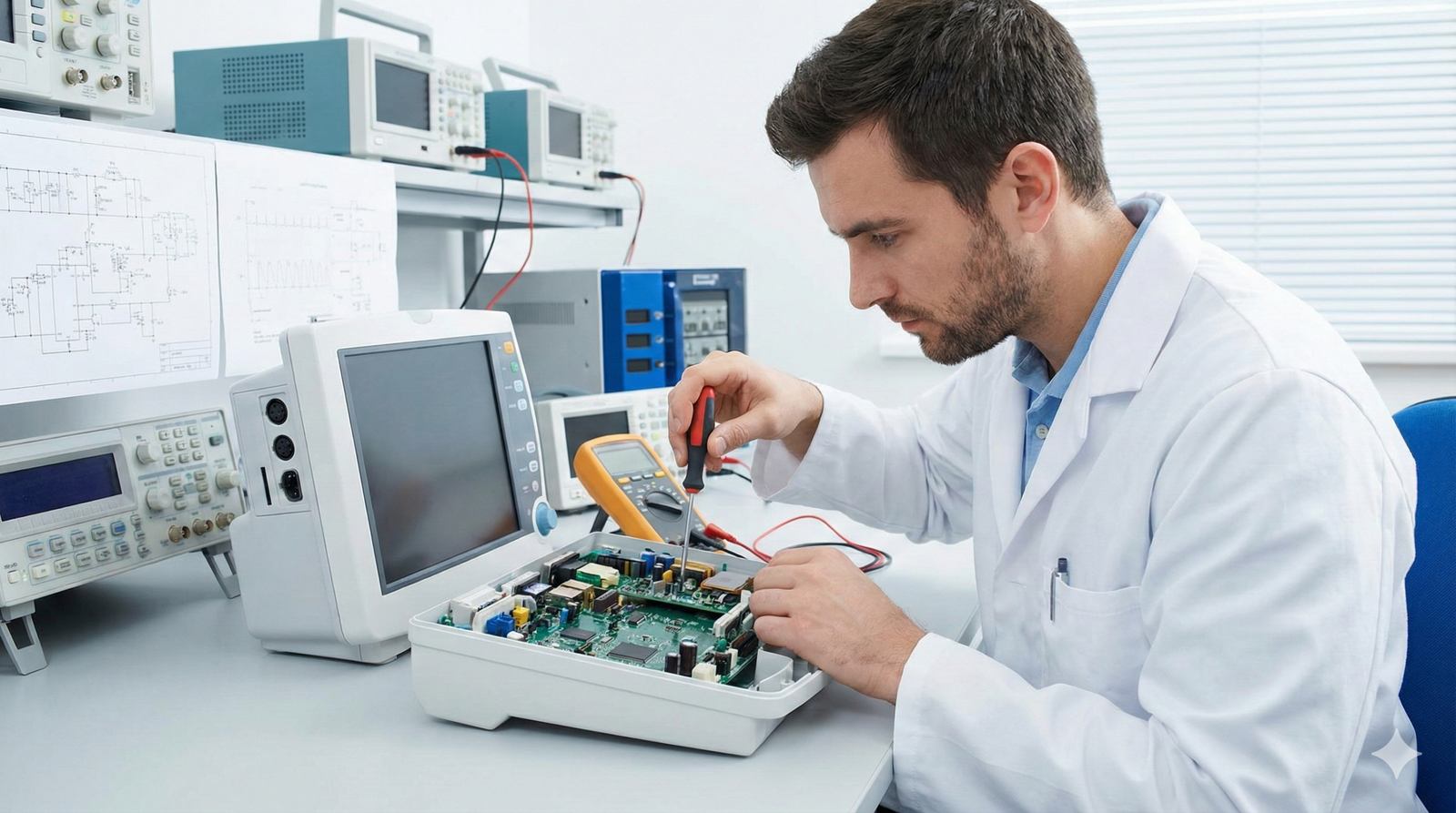
What Biomedical Equipment Technicians Actually Do in an Indian Hospital
The job description on a hospital’s career page will say “maintain and repair medical equipment.” That description fits everything from a blood pressure cuff to a 1.5-Tesla MRI machine, which is a bit like saying a plumber “works with pipes.”
Here is what the work actually breaks down to:
Preventive Maintenance (PM) — roughly 40–50% of your time
Every device has a manufacturer-specified maintenance schedule. NABH (National Accreditation Board for Hospitals and Healthcare Providers) accreditation requires hospitals to follow documented PM protocols and maintain calibration records. When the NABH surveyor visits, the Biomedical department’s paperwork is a primary audit checkpoint.
A standard PM round on an ICU ventilator involves testing flow accuracy with a calibrated gas flow analyser, checking circuit integrity, running the built-in diagnostic routines, and updating the asset management log. If a unit’s delivered volume drifts outside the ±5% tolerance — say, it delivers 520 mL on a 500 mL setting — the unit is pulled from service and a loaner goes in. That decision happens in the workshop, not in a meeting.
Corrective Maintenance (repair) — roughly 30–40% of your time
A nurse pages you: “Room 7, the syringe pump is showing E-04 error and the ICU resident is asking for it now.” You check the service manual, isolate whether it’s a motor fault, a sensor fault, or a software flag, and either resolve it at the bedside or swap a tested backup unit and bring the failed one to the workshop.
This is where the pressure lives. In a private hospital with a NABH or JCI accreditation, equipment downtime has direct billing implications. A functional cath lab generates revenue; a cath lab with a broken X-ray image intensifier does not.
Equipment Lifecycle and Regulatory Compliance — 10–20% of your time
New equipment arriving at a hospital must pass incoming inspection before clinical deployment. Equipment generating ionising radiation — C-arms, portable X-rays, CT scanners — requires AERB (Atomic Energy Regulatory Board) compliance checks. Medical devices under the Medical Devices Rules 2017 (enforced by CDSCO) must have proper procurement documentation. When equipment is decommissioned, the disposal process has documentation requirements tied to biomedical waste and data.
In larger departments, this administrative layer also includes vendor coordination, AMC (Annual Maintenance Contract) review, spare parts procurement, and reporting to the hospital administration on uptime metrics.
The India-Specific Reality: Government Hospital vs Private Chain vs OEM Service
This is the part most career guides skip entirely. The BMET job in an AIIMS department, in an Apollo multi-speciality, and at GE Healthcare’s field service division are three entirely different working lives.
Government Hospitals (AIIMS, ESIC, Railway Hospitals, Defence Medical Services)
Pay is structured on the 7th Pay Commission scale. A fresh BMET-equivalent joining as a Junior Technical Officer or Technical Assistant (Group B, non-gazetted) would typically be in the Level 5–6 pay matrix, with gross salary (basic + DA + HRA) often ranging from ₹35,000 to ₹55,000 per month depending on the city and posting. Senior positions reach Level 8–10.
The real value proposition is stability, not income. There is no attrition in government hospitals. There is a pension. The equipment exposure is often exceptional — AIIMS New Delhi, AIIMS Bhopal, and regional AIIMS campuses run high-end imaging systems, specialised surgical suites, and research-grade laboratory equipment that many private hospitals don’t touch. The learning curve in the first three years is steep in the best way.
The challenge: procurement is slow (government tendering processes), spare parts wait times can stretch months, and the workload-to-staff ratio at public hospitals is frequently unforgiving.
Private Hospital Chains (Apollo, Fortis, Manipal, Narayana Health, Max Healthcare)
Salaries at established private chains are more competitive than government scale but still employer-dependent. Based on ERI SalaryExpert data (salary surveys conducted across Indian employers, updated 2026), the national average gross salary for a biomedical equipment technician in India is approximately ₹8.92 LPA. Entry-level (1–3 years experience) averages ₹6.55 LPA; senior-level professionals (8+ years) average ₹11.14 LPA.
City-level variation is significant. Mumbai commands a ₹9.85 LPA average (entry ₹7.23 LPA, senior ₹12.30 LPA). Hyderabad sits at ₹9.38 LPA average (entry ₹6.89 LPA, senior ₹10.75 LPA). Smaller Tier-2 cities run 15–25% below national average.
In practice, a BMET at a mid-tier private hospital often earns ₹3–5 LPA at entry and reaches ₹7–10 LPA with 5–7 years of experience and IBSC certification. Large chains with centralised biomedical departments (Apollo has one of the largest HTM setups in India) pay more and offer structured training on high-end imaging and surgical equipment.
The pressure at private hospitals is commercial in a way that government hospitals are not. Equipment downtime means lost surgical bookings. This translates into urgency that some people find energising and others find exhausting.
OEM Field Service Engineers (GE Healthcare India, Siemens Healthineers India, Philips Healthcare India, Draeger India)
This is where compensation jumps significantly. OEM field service roles — engineers who maintain and repair equipment for specific manufacturers across multiple client hospitals — pay ₹6–12 LPA for 1–5 years of experience and ₹10–16 LPA for senior specialists and lead engineers, according to industry data compiled by Harvey Biomedical (a specialist Indian biomedical training organisation). Top performers at GE Healthcare India and Siemens Healthineers India with 8–10 years of CT or MRI specialisation and strong certification history can reach ₹18–22 LPA in total compensation including incentives.
The trade-off is travel. A GE service engineer based in Hyderabad may be covering hospitals across Telangana and Andhra Pradesh. The travel allowance, vehicle arrangement, and per-diem structures vary by company, but the job is not desk-based.
Indian manufacturers — BPL Medical Technologies (Bengaluru), Skanray Technologies (Mysuru), Meril Life Sciences, Cyrix Healthcare — also hire biomedical engineers for field service, quality assurance, and testing roles at ₹3–10 LPA depending on role level. Joining an Indian medtech manufacturer early gives exposure to the full device lifecycle in a way that hospital service roles don’t.
Salary Summary Table
| Employer Type | Entry (1–3 yrs) | Mid (4–7 yrs) | Senior (8+ yrs) |
|---|---|---|---|
| Government (AIIMS/ESIC/Defence) | ₹3.5–5.5 LPA | ₹5.5–8 LPA | ₹8–12 LPA |
| Private Hospital Chain | ₹3–6 LPA | ₹6–10 LPA | ₹9–14 LPA |
| OEM Field Service (GE, Siemens, Philips) | ₹6–12 LPA | ₹10–16 LPA | ₹16–22+ LPA |
| Indian Medtech Manufacturer | ₹3–6 LPA | ₹5–10 LPA | ₹10–15 LPA |
Sources: ERI SalaryExpert India salary surveys (2026 data), Harvey Biomedical India industry data (January 2026). Figures represent CTC gross; take-home will vary based on tax structure and employer PF contributions.
Education Pathways in India: From ITI to Postgraduate
Unlike nursing or radiography, there is no single mandatory qualification to work as a BMET in India. This creates flexibility for people entering from different starting points, but also means that the quality of training varies enormously. Here is the honest breakdown.
Route 1: ITI in Medical Electronics (NSQF Level 4)
The Directorate General of Training (DGT) under the Ministry of Skill Development & Entrepreneurship offers a Craftsman Training Scheme (CTS) trade in Medical Electronics at the NSQF Level 4. The trade is 2 years, taught at ITI-affiliated institutes, and covers DC/AC circuits, medical terminology, basic patient monitoring equipment, ECG machines, infusion pumps, and foundational safety testing.
Eligibility: 10th standard (matriculation) pass.
Cost: Negligible at government ITIs (₹500–₹2,000 fees); private ITIs vary.
This is the entry point for candidates from non-engineering backgrounds who want to get into the field with the lowest cost and fastest timeline. The limitation is that ITI-level qualification caps you at junior technician roles without further upskilling. However, it qualifies you for the NCVT National Trade Certificate, which is government-recognised.
Route 2: Diploma in Biomedical Engineering / Medical Electronics / Biomedical Instrumentation (3 years after 10th)
This is the most common entry route for people who want to go directly into hospital BMET roles or OEM service. Polytechnic institutes across India (AICTE-approved) offer diplomas in Biomedical Engineering, Biomedical Instrumentation, or Medical Electronics. The curriculum is broader than ITI — covering digital electronics, microprocessor basics, imaging fundamentals, hospital equipment operation, and basic NABH/regulatory compliance.
Cost: Government polytechnics charge ₹15,000–₹40,000 total for 3 years. Private polytechnics range from ₹80,000–₹2,50,000.
A diploma holder with 2 years of hospital experience is the standard profile for a Biomedical Technician or Junior Biomedical Engineer position at a private hospital or third-party service company. This is also the minimum qualification required for the IBSC Certificate in Biomedical Maintenance (see certifications below).
Route 3: B.E./B.Tech in Biomedical Engineering (4 years after 12th)
For those who want to work in OEM field service, medical device quality assurance, regulatory affairs, or eventually move into clinical engineering management, a biomedical engineering degree is the stronger long-term investment. Recruiters at GE Healthcare India and Siemens Healthineers India list B.E./B.Tech as preferred for field service engineer roles, though they do hire experienced diploma holders.
Starting salary for a fresh B.Tech biomedical graduate at a top medtech firm ranges from ₹5–10 LPA (selectyouruniversity data, 2025). Medtronic, Tata Elxsi, and Philips have been among the recruiters at established biomedical engineering programmes.
Top colleges with verified placement records in biomedical engineering include VIT Vellore, SRM University, Manipal Institute of Technology, PSG College of Technology (Coimbatore), and Sathyabama Institute of Science and Technology (Chennai). AIIMS New Delhi and IIT Bombay offer postgraduate-level programmes in biomedical engineering for those targeting research or senior clinical engineering roles.
Route 4: IBSC Online Certificate Programs (For Working Professionals)
If you are already working in a hospital’s biomedical department or have an electronics/engineering background and want to transition into biomedical work, the Indian Biomedical Skill Consortium (IBSC) offers the most accessible formal credential in India.
IBSC was established by the Andhra Pradesh MedTech Zone (AMTZ) jointly with the Association of Indian Manufacturers of Medical Devices (AiMeD) and the Quality Council of India (QCI). Its programmes are approved by the National Skill Qualification Framework (NSQF) under the National Skill Development Corporation (NSDC), Ministry of Skill Development and Entrepreneurship. This is not a private certification body — this is a government-backed skill development institution.
The key certifications available through IBSC:
- Certificate in Biomedical Engineering — entry-level, for final-year students and recent graduates in biomedical/medical electronics fields; online MCQ assessment; government-recognised
- Certificate in Biomedical Maintenance — mid-level, for working professionals with diploma + 2 years experience or B.Tech + 2 years experience; covers X-ray, CT, MRI, ultrasound, ventilators, anaesthesia machines, and administrative/compliance duties
- Online Training + Assessment on Medical Equipment Maintenance — for working professionals covering preventive maintenance, troubleshooting, and calibration of critical care, surgical, and radiology equipment; fee for Indian nationals: ₹19,500 (covers training + assessment + e-certificate)
- PG Certificate in Medical Equipment Maintenance & Service — for senior professionals; includes a module specifically on NABH, JCI, and ISO compliance for running a biomedical department
The critical detail: IBSC has a mutual recognition agreement with AAMI (Association for the Advancement of Medical Instrumentation, the US body that administers the CBET certification). This means IBSC-certified biomedical engineers are given equivalent standing to AAMI-certified professionals internationally. If you are considering working in the Gulf countries, Southeast Asia, or eventually qualifying for global roles, IBSC certification carries weight that a purely institutional certificate does not.
Website: ibsc-amtz.in
BEMC Scheme (Biomedical Equipment Maintenance Certification)
AMTZ has also launched the BEMC (Biomedical Equipment Maintenance Certification) Scheme in collaboration with AiMeD (Association of Indian Medical Device Industry) and AHPI (Association of Healthcare Providers India). This scheme is specifically aimed at establishing a national standard for biomedical maintenance competency within Indian hospitals. Watch this space — as NABH and CDSCO tighten documentation requirements, BEMC-linked credentials are likely to become increasingly referenced in hospital HTM job descriptions.
NABH and AERB: The Regulatory Reality That Changes Everything
Most career guides written outside India will mention the Joint Commission or FDA. In India, the regulators that matter day-to-day are different.
NABH (National Accreditation Board for Hospitals and Healthcare Providers)
NABH accreditation is now effectively mandatory for hospitals that want empanelment under Ayushman Bharat schemes and most state government insurance programmes. The NABH standards include specific requirements for equipment management: documented PM schedules, calibration records, equipment tracking, and user training documentation. All of this is the biomedical department’s responsibility.
When a hospital prepares for NABH re-accreditation, the biomedical team’s documentation is under direct scrutiny. This creates job security — a hospital that wants to keep its NABH status cannot afford to run a weak biomedical department.
AERB (Atomic Energy Regulatory Board)
Any biomedical technician working on or near radiation-emitting diagnostic equipment — portable X-ray units, C-arms (used in every OT across India), CT scanners, fluoroscopy systems, nuclear medicine gamma cameras — operates under AERB jurisdiction. AERB requires dosimetry monitoring for staff with significant radiation exposure and mandates specific qualification and training standards for personnel servicing radiological equipment.
This is worth knowing before you join. If you’re working on a C-arm in an orthopaedic OT, your AERB badge reading matters. Proper PPE (lead aprons, thyroid shields) and positioning protocols are not optional guidelines — they’re regulatory requirements.
CDSCO (Central Drugs Standard Control Organisation)
The Medical Devices Rules 2017 under CDSCO regulate the import, manufacture, and sale of medical devices in India. For a working BMET, CDSCO matters primarily at the procurement and incoming inspection stage — ensuring equipment has valid import licenses and manufacturer authorisation before it enters clinical use.
What the Career Sites Won’t Tell You About BMET in India
Three things that rarely appear in job descriptions but significantly affect your daily life in this role:
1. The AMC gap is your biggest problem.
Hospitals — especially smaller private hospitals and government facilities — routinely let Annual Maintenance Contracts lapse due to budget pressure. When an AMC lapses, you lose access to manufacturer technical support, original spare parts at contracted rates, and software update entitlements. You are now troubleshooting proprietary equipment without official documentation or OEM assistance. This is where the skill actually gets tested. It’s also where ethical lines get blurry: using non-OEM parts on life-critical equipment is a real-world situation that hospitals sometimes create for BMETs.
2. The IT collision is coming whether your hospital is ready or not.
Modern hospital equipment in India — PACS servers (for radiology imaging), ventilator management systems, patient monitor central stations, infusion pump fleet management — runs on hospital networks. Biomedical and IT departments historically didn’t talk much. That is changing fast. NABH standards now reference cybersecurity for medical devices. Philips, GE, and Siemens push mandatory firmware updates for networked devices. The BMET who understands VLANs, basic network segmentation, and how hospital information systems interact with device middleware will be significantly more employable than one who does not.
3. Tier-2 cities are where the actual shortage is.
Hyderabad, Bengaluru, and Mumbai have functioning pipelines of biomedical graduates. A 300-bed private hospital in Madurai, Nagpur, Raipur, or Bhubaneswar trying to get NABH accreditation is often working with a single biomedical technician covering the entire facility. The workload is extreme. But the negotiating leverage for a qualified person is also higher, and many hospital groups opening Tier-2 campuses are actively recruiting.
Career Progression: Where Can This Actually Go?
Entry-level roles in Indian hospitals and service organisations are titled Biomedical Technician, Junior Biomedical Engineer, or Service Engineer. From there, the progression has three distinct directions:
Technical Specialisation Track
Moving from generalist BMET to specialised imaging engineer (CT, MRI, ultrasound), cardiac equipment specialist, or OT equipment specialist. This is the highest-paying technical track without management responsibility. An MRI specialisation at a GE or Siemens service centre, with 7–10 years of experience and multiple manufacturer certifications, can command ₹18–22 LPA. The catch: MRI specialisation requires manufacturer-specific training programmes that are typically company-sponsored, meaning you need to be employed by an OEM or authorised service partner to access them.
Clinical Engineering Management Track
Senior Biomedical Engineer → Biomedical Manager → Clinical Engineering Head / HTM Head. At large hospital chains (Apollo’s centralised clinical engineering team manages biomedical departments across 70+ hospitals), this path reaches Director-level positions with salaries in the ₹18–28 LPA range. Reaching this level generally requires a degree (not just diploma), IBSC mid-to-senior certification, and a track record in NABH audit preparation. Some professionals in this track pursue a PG diploma in Healthcare Management alongside their technical credentials.
OEM / Medtech Industry Track
Moving from hospital service into the medical device industry itself — in field service, application support, technical sales, quality assurance, or regulatory affairs. This is a significant career transition that some experienced BMETs make at the 5–8 year mark. The income ceiling is higher (regulatory affairs managers at multinationals reach ₹20–30 LPA), but the work becomes less hands-on and more documentation-intensive.
How This Compares to an IT Career at the Same Education Level
This is the question that readers on careerskillguide.com are actually asking, even if they don’t phrase it that way.
A diploma-level IT support engineer or hardware technician at an IT services company in India earns ₹2.5–4.5 LPA at entry level. A diploma-level biomedical technician at a private hospital starts at ₹3–5 LPA in metro cities — comparable to IT support, not significantly better.
The divergence happens at the 5-year mark:
- An IT support engineer who has not moved into software, cloud, or cybersecurity is likely earning ₹5–8 LPA and facing intense competition from fresher hires.
- A biomedical technician with 5 years of hospital experience, an IBSC Certificate in Biomedical Maintenance, and demonstrated competence on imaging equipment is earning ₹8–12 LPA with meaningful upward trajectory and much lower competition at the senior level.
The BMET path is not a shortcut to high salaries. It is a slower build with better long-term security and less commoditisation risk. Preventive maintenance of a hospital ventilator cannot be offshored or automated. The same cannot be said for many IT support functions.
The person this career is wrong for: anyone who needs ₹6+ LPA within 12 months of starting, anyone who cannot tolerate occasional exposure to clinical environments, and anyone unwilling to continue learning as equipment technology changes.
The person this career is right for: someone from an electronics or engineering background who wants work that matters tangibly, that exists in every city in India, and where experience and certification create a durable, growing advantage over time.
Your Next Three Steps
Step 1: If you do not yet have any formal qualification, visit the DGT ITI portal (dgt.gov.in) and search for ITI institutes in your city offering the Medical Electronics trade. This is the lowest-cost, fastest entry point.
Step 2: If you already hold a diploma or B.E. in a related field and want a recognised certification while working, visit ibsc-amtz.in and review the Certificate in Biomedical Engineering or Certificate in Biomedical Maintenance based on your experience level. The online format means there is no geographic constraint.
Step 3: Search Naukri.com for “biomedical technician” and “biomedical engineer” in your target city. Read 10–15 job descriptions carefully. The qualifications listed, the equipment types mentioned, and the salary bands disclosed (where visible) will give you the most accurate current picture of what employers in your specific market are actually hiring for.
Frequently Asked Questions
Is there a government licence required to work as a BMET in India?
No statutory licence is currently required to work as a biomedical equipment technician in India, unlike doctors or nurses. However, working on AERB-regulated radiation-emitting equipment has specific regulatory requirements, and hospitals with NABH accreditation require documented competency records for biomedical staff. The IBSC certification system is the closest thing India has to a formal professional credentialing standard for this role.
Can I get a biomedical technician job in India with just an ITI certificate?
Yes, at the junior technician level in smaller hospitals or third-party service companies. However, progression beyond a junior role without a diploma or degree qualification is limited. Most mid-level hospital positions require at minimum a diploma in Biomedical Engineering or Medical Electronics.
What is the difference between a Biomedical Technician and a Biomedical Engineer in India?
In practice, this is an employer-defined distinction more than a regulatory one. Hospitals with formal HTM departments typically use “Technician” for diploma holders performing hands-on maintenance and “Engineer” for degree holders taking broader responsibility including vendor management, NABH documentation, and technical specification for equipment procurement. OEM companies tend to hire degree holders as “Service Engineers” or “Field Application Engineers.”
Is IBSC certification the same as CBET?
They are separate certifications from separate bodies, but IBSC and AAMI have a mutual recognition agreement. An IBSC-certified professional is given equivalent standing to an AAMI-certified professional in terms of global recognition. CBET (Certified Biomedical Equipment Technician) from AAMI remains the standard for work in the US; IBSC is the appropriate credential for work in India and recognised internationally under the mutual recognition agreement.
Which cities have the most biomedical technician jobs in India?
Bengaluru, Hyderabad, Mumbai, Chennai, and Delhi/NCR have the highest volume of openings due to concentration of large hospital chains and OEM regional offices. However, demand in Tier-2 cities (Pune, Ahmedabad, Lucknow, Kochi, Bhubaneswar) is growing faster as Ayushman Bharat-linked hospital expansion accelerates and those facilities pursue NABH accreditation.
Data sources: ERI SalaryExpert India salary surveys (2026 data); Harvey Biomedical India career scope report (January 2026); IBEF India Medical Devices Industry report; Mordor Intelligence India Medical Devices Market report (2026); Fortune Business Insights India Medical Devices Market (2026); IBSC-AMTZ programme documentation; DGT/NCVT Medical Electronics trade curriculum; NABH accreditation standards. Salary figures are gross CTC estimates; actual take-home varies.
Last Verified: May 2026. Next Review: November 2026.